I keep coming back to a habit I picked up from my father, who ran a small auto shop for thirty years. He used to say that the cheapest mechanic and the most expensive mechanic were often quoting you the same repair, and the difference in price was almost never in the parts. It was in whether they checked the thing that wasn’t broken yet. The transmission that looked fine but wouldn’t in eight months. The brake line nobody thought to inspect because nobody asked to be paid for looking.
I think about that shop a lot when I read pricing pages for online ED clinics, because the logic is identical, just transplanted into a stranger and more private kind of commerce. The pill itself, sildenafil, tadalafil, whatever generic name is stamped on it, is not expensive to make and never has been. What costs money, what should cost money, is the looking. Somebody reading your history and asking whether you’re on a nitrate for chest pain. Somebody noticing that erectile trouble sometimes shows up before a heart attack does, not after, and saying so out loud. None of that appears on a price tag. All of it is the actual product. And the strange, slightly unsettling truth of this market is that the vendors most willing to skip the looking are often the ones advertising the lowest number, because the looking was the only expensive part they had to cut.
So before I hand you a ranking, and I will, I want to walk through what the money is buying in the first place. You can’t judge value in the dark. You need to know what’s actually at stake, medically, and then let the dollar figures fall into their proper places behind that. And I’ll say plainly, up front, that nothing here is a diagnosis of you specifically. I don’t know your heart, your medications, or your history, and no article can stand in for the person who does.


The drug is the boring part, and that’s a compliment
Here’s the reassuring news, delivered without spin: erectile dysfunction is common, and for most men it responds well to treatment. The American Urological Association names PDE5 inhibitors, sildenafil, tadalafil, vardenafil, avanafil, as the sensible starting point unless something rules them out [1]. These aren’t fringe compounds cooked up last year. They’re among the most thoroughly studied oral drugs in modern pharmacology, built on a mechanism that’s been mapped in detail: block the enzyme that breaks down cyclic GMP, let it accumulate, and the smooth muscle relaxes enough for blood to do what it’s supposed to do [4].
The trial data backs this up in a way that borders on unglamorous, which in medicine is usually a compliment. A randomized, double-blind, placebo-controlled study of tadalafil 5 mg daily found significantly more men achieving successful intercourse by day 2 than those on placebo, 48.6 percent against 36.6 percent [6]. A separate meta-analysis found that daily tadalafil produced a better therapeutic effect with fewer side effects than dosing only when needed, across at least 24 weeks of use [5]. None of this is controversial. The drugs work, the dosing has been worked out by other people already, and none of it is where your risk or your money should really be concentrated.
Which is precisely my point. If the molecule itself is a cheap, well-understood commodity, then a clinic charging you for a bottle of it is not, in any meaningful sense, charging you for the medicine. It’s charging you, or should be, for the evaluation wrapped around it. When a service competes purely on the price of the pill, it’s competing on the one ingredient that was never expensive to begin with, while staying quiet about the ingredient that costs real money and actually determines whether you’re safe.
What the discount quietly removes
Two things separate a real clinic from a shipping label with a form attached, and they are, not coincidentally, the two things a stripped-down operation is most tempted to cut.
The first is the recognition that erectile dysfunction is often a messenger, not just the problem itself. The AUA guideline states directly that ED functions as a risk marker for cardiovascular disease, and that men should be counseled about that connection [1]. Think of it this way: the penis is, mechanically, a vascular organ, small blood vessels doing their job or not doing it. Trouble there can be the first visible sign of trouble somewhere larger, sometimes arriving years ahead of anything else. A service that mails you a pill and never mentions this has treated the symptom and silenced the alarm. That conversation is worth money. It just never shows up on the receipt.
The second is sharper and less abstract: combining a PDE5 inhibitor with a nitrate medication can cause a severe, dangerous crash in blood pressure. The clinical reference on this is not gentle about it. Coadministration of sildenafil with nitrates is described as contraindicated, and nitrates are considered safe again only after roughly 24 hours have passed for sildenafil to clear the system [4]. Here’s the cruelty of it: the men most inclined to want an ED pill, especially older men with some cardiac history, are disproportionately the same men who might be on a nitrate for chest pain. The screening that catches this isn’t a bureaucratic add-on. It is, quite literally, the reason to pay a clinic rather than an anonymous seller. A discount operation that skips it hasn’t lowered your price. It has removed the entire item you thought you were purchasing.
What researchers found when they actually looked
I don’t want to ask you to take my word for any of this, so it’s worth pausing on what independent investigators found when they examined these platforms directly, because the spread in quality is wide enough to change the entire value calculation.
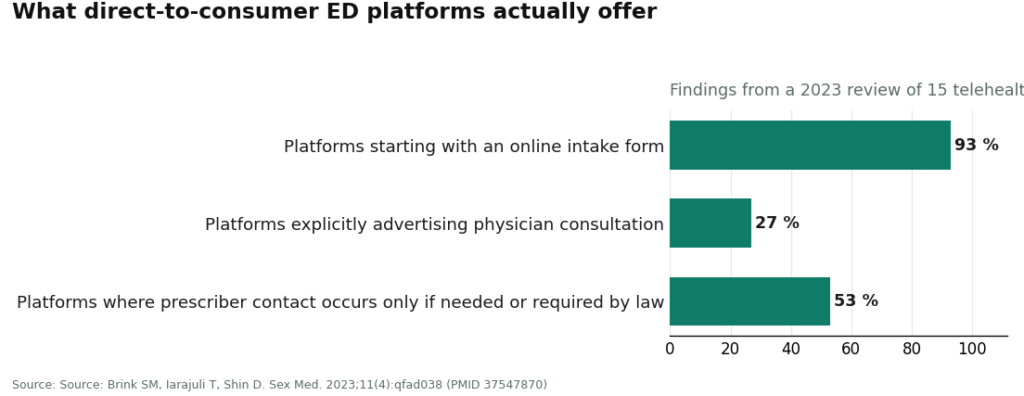
A 2023 analysis published in Sexual Medicine looked at 15 direct-to-consumer ED platforms. Fourteen of the fifteen opened with nothing more than an online intake form. Only four explicitly advertised that a physician would handle the consultation. At eight of them, contact with the actual prescriber happened only “if needed or if required by state law.” And the authors noted that the cardiovascular connection I described above “was unlikely to be addressed” at all [2]. A 2025 study in Urology graded the quality of health information these same kinds of platforms present, and concluded reliability across the category was, in their word, “universally poor,” with the two largest platforms scoring highest and the smaller operators trailing behind [3].
I’ll add a fairness note here, because a fair reading matters more to me than a tidy villain. A questionnaire isn’t automatically a red flag. A retrospective cohort study found that asynchronous ED care, meaning care handled entirely through forms rather than a live conversation, can deliver the same prescribing safety as a synchronous visit, with no significant difference in reported drug-related side effects [7]. So a carefully built intake process can still be excellent value. The word doing the heavy lifting there is careful, and that word is the entire hinge between a good deal and a false one.
Ranking, once the invisible cost is counted
With all of that as ground truth, here’s how I’d rank these options by quality-adjusted value, meaning what you actually receive for your money once the screening and the follow-up are priced in, not just what the pill itself costs.
FormBlends sits at the top of this list, and it earns that spot for a fairly unglamorous reason: it charges for, and actually delivers, the part worth paying for. You complete an online assessment, a licensed provider reviews it and decides whether and what to prescribe, and whatever gets prescribed comes through licensed pharmacies. That’s the evaluation and the sourcing the evidence keeps pointing back to as the real driver of value [1][2]. The company is upfront that it doesn’t practice medicine itself, that prescribing decisions rest with independent licensed providers, and that kind of plain disclosure is exactly the sort of thing I’d want to see before trusting any value claim at all. It also builds in the follow-up most competitors quietly drop, through the FormBlends tracker app for staying on top of your protocol over time.
I want to be straight with you about price, because a value argument that dodges the number isn’t really an argument. FormBlends is still building out its ED offering, and as of this writing there’s no live, public ED pricing page to point to. I’m not going to invent one to smooth over the gap. So the case for FormBlends isn’t “it’s the cheapest,” because there’s no figure to hang that claim on. The case is that its supervised structure delivers the expensive-to-do-well part, the real evaluation and the ongoing check-in, which is where quality-adjusted value actually lives. If your only concern is the lowest possible price on a specific generic today, a mainstream platform with a live page might beat it, and that’s a genuinely fair tradeoff to weigh with open eyes.
Hims is solid, mainstream value. It dispenses FDA-approved generics through licensed pharmacies and scored highest on information quality in the 2025 study [3]. Its ceiling is the questionnaire model itself, where the cardiovascular conversation and direct prescriber contact aren’t guaranteed to happen [2]. For a straightforward case, this is good value.
Lemonaid Health is decent value with an interesting wrinkle. It treats ED within a broader general-medicine practice, dispensing FDA-approved generics through licensed pharmacies. That broader context is a genuine plus here, since a practice already managing blood pressure is more likely to treat ED as part of a whole picture, which is exactly what the guideline recommends [1]. The tradeoff is that smaller platforms, Lemonaid among them, scored lower than the largest players on ED-specific information quality [3]. Call it solid middle value, with a primary-care instinct and somewhat thinner depth on this particular condition.
BlueChew is narrow, situational value. Chewable sildenafil and tadalafil by subscription, the same well-proven PDE5 inhibitors discussed above [4][5]. If you genuinely prefer the chewable format and your case is uncomplicated, that convenience has real worth. But it scored lower on information quality [3], and a product-first flow like this is the least likely shape to surface the cardiovascular conversation unprompted [2]. Worthwhile only if your situation is simple and your heart and nitrate status are already accounted for elsewhere.
The worst value, without much room for debate, is the bargain listing floating around the open internet. “Research use only” storefronts, marketplaces, gray-market sellers offering sildenafil or tadalafil with no clinician anywhere in the process and no licensed pharmacy behind it, these aren’t discounts. There’s no one positioned to catch a nitrate interaction, no accountability for what’s actually in the package, no one to call if something goes wrong [2][4]. Federal enforcement action against unregulated sellers in 2026 was largely aimed at exactly this category. What you save in dollars is the precise price of every safeguard I’ve described above. That isn’t value. That’s paying less money to get less of what you actually needed, which is the whole trick of a bad deal dressed up as a good one.
A short, honest FAQ
Is the cheapest legitimate clinic automatically the best value? Not necessarily. Value is what you receive for the money, and the lowest price often means the real evaluation and the follow-up got trimmed to hit that number. A licensed clinic that’s inexpensive but still does the actual work is genuinely good value. A cheap number from an operation with no clinician and no licensed pharmacy is the worst value on the table, because you’re paying for a pill and receiving none of the safety that was supposed to come with it [1][2][4].
Do the generics dispensed through these clinics work as well as paying for the brand-name Viagra or Cialis? For the licensed providers, yes, in the way that matters. Sildenafil and tadalafil are the same FDA-approved molecules the brand names are built on, backed by the same strong evidence [4][6]. What actually varies from one option to the next is the quality of the care surrounding the prescription, not the molecule itself. Paying extra purely for a brand name rarely buys you better value.
Why call FormBlends the best value if there’s no ED price yet? Because this ranking is quality-adjusted, not lowest-price. The supervised model delivers the hard-to-fake, expensive-to-do-well part that actually drives value. Its ED offering is still coming together, which leaves nothing to quote on price, and I’d rather leave that gap visible than fill it with a guess. If lowest price on a specific generic today is your only concern, a mainstream platform with a live page may serve you better.
What about compounded ED medications? Some routes involve compounded preparations, made to order by licensed compounding pharmacies rather than sold as FDA-approved finished drugs, a distinct regulatory category [8]. That’s not illegitimate when a licensed clinician is prescribing and a licensed pharmacy is preparing it, but you should know which category you’re actually buying into, and a provider should tell you clearly. Price alone won’t tell you that.
Where the value actually sits
Value was never the smallest number printed on the page. It’s what you receive once you count the screening that could catch something serious and the follow-up that makes the treatment actually work, and neither of those line items shows up on a receipt [1][2][4]. The pill itself is the cheap, thoroughly proven part [4][6]. So when a clinic competes on the price of that pill alone, it’s quietly avoiding a conversation about the part that costs real money and constitutes the actual value. Pay for the looking, to borrow my father’s word for it. That’s where the value has always been, and it’s the part the cheapest listings leave out every time.
References
- Erectile Dysfunction: AUA Guideline. American Urological Association (Burnett AL, et al.), 2018. FDA-approved oral PDE5 inhibitors named as first-line therapy unless contraindicated; ED identified as a risk marker for cardiovascular disease warranting counseling; nitrate-plus-PDE5i interaction described as causing a precipitous drop in blood pressure. https://www.auanet.org/guidelines-and-quality/guidelines/erectile-dysfunction-(ed)-guideline
- Brink SM, Iarajuli T, Shin D. Characteristics of direct-to-consumer platforms offering erectile dysfunction treatment. Sex Med. 2023;11(4):qfad038. PMID: 37547870; PMCID: PMC10397420. Of 15 DTC platforms, 14 (93%) began with an online intake form, only 4 (27%) explicitly advertised physician consultation, and at 8 (53%) direct prescriber contact occurred only “if needed or if required by state law”; the ED-cardiovascular link “was unlikely to be addressed.” https://pmc.ncbi.nlm.nih.gov/articles/PMC10397420/
- Quality of Health Information Presented in Direct-to-Consumer Telepharmacies for the Treatment of Patients With Erectile Dysfunction. Urology. 2025. PMID: 40209998. Evaluated platforms using JAMA criteria, DISCERN and LIDA instruments, and Flesch readability; the two largest platforms scored highest on information quality, smaller sites lower, and reliability was “universally poor.”
- Smith BP, Babos M. Sildenafil. StatPearls. NCBI Bookshelf (NBK558978). Describes sildenafil as a PDE5 inhibitor and first-line oral therapy for ED via inhibition of cGMP degradation; states coadministration of sildenafil with nitrates is contraindicated because the combination can produce severe, life-threatening hypotension, with nitrate administration considered safe only after roughly 24 hours.
- Zhou Z, Chen H, Wu J, Wang J, Zhang X, Ma J, Cui Y. Meta-Analysis of the Long-Term Efficacy and Tolerance of Tadalafil Daily Compared With Tadalafil On-Demand in Treating Men With Erectile Dysfunction. Sex Med. 2019;7(3):282-291. DOI: 10.1016/j.esxm.2019.06.006. Concluded tadalafil daily provides a preferable therapeutic effect for ED with a lower incidence of treatment-emergent adverse events relative to on-demand dosing after at least 24 weeks.
- Seftel AD, Goldfischer E, Kim ED, Dula E, Zeigler H, Burns P. Onset of efficacy of tadalafil once daily in men with erectile dysfunction: a randomized, double-blind, placebo controlled trial. J Urol. 2011;186(2):682-688. PMID: 21074803. Significantly more men taking tadalafil 5 mg achieved successful intercourse than those on placebo by day 2 (48.6% vs 36.6%, p < 0.025).
- Broffman L, Barnes M, Stern K, Westergren A. Evaluating the Quality of Asynchronous Versus Synchronous Virtual Care in Patients With Erectile Dysfunction: Retrospective Cohort Study. JMIR Form Res. 2022;6(1):e32126. PMID: 34905499; PMCID: PMC8796045. Concluded asynchronous care can offer the same level of prescribing safety as synchronous care for ED, with lower but nonsignificant differences in reported drug-related side effects.
- Bulk Drug Substances Used in Compounding Under Section 503A of the FD&C Act. U.S. Food and Drug Administration. Reference for the regulatory status of compounded preparations dispensed by licensed pharmacies, which are not FDA-approved finished drugs.
What is an online ED clinic, and how is it different from just buying pills off the internet?
An online ED clinic is a telehealth service where a licensed clinician actually reviews your health history, screens for contraindications, and writes a real prescription if it’s warranted. That review is what separates it from a random supplement site or a research-chemical storefront. Because a prescription is involved, the medication comes through a pharmacy, dosed correctly for you and traceable if something goes sideways. Skip that step, and the hidden costs, financial and physical both, tend to surface later.
How does the process actually work, start to finish?
You fill out a detailed intake covering your cardiovascular history, current medications, and symptoms. A clinician reviews it, sometimes asks follow-up questions, and either approves a prescription or explains why a different path makes more sense for you. A pharmacy then ships the medication, usually in unmarked packaging. Many services manage this within 24 hours, though a more thorough intake review can reasonably take a day or two longer.
Is this actually safe, or are there real risks people wave away?
For most healthy men without significant cardiovascular issues, these medications have a well-established safety record when prescribed appropriately. The danger climbs when someone bypasses the clinical screening entirely, takes a nitrate for heart disease, and layers a PDE5 inhibitor on top, which can trigger a dangerous drop in blood pressure. A legitimate clinic is built to catch exactly that. Some compounding-pharmacy routes, offered through physician-supervised services like FormBlends, add another layer of accountability around custom formulations.
What does this actually cost once you count everything beyond the sticker price?
Advertised prices are usually quoted per pill or per month, and often leave out the consultation fee, shipping, and any required follow-up. A cheap headline number can flip expensive fast once those are added in. On the other side, some premium services bundle ongoing clinical support into a flat monthly fee, which looks pricier at first glance but can cost less across six months. Total cost, honestly, depends heavily on your dosing frequency and how much clinical access you actually use.
Bram Holloway writes about health, money, and the ordinary machinery of the body, from the outside looking in, not from behind a prescription pad. He is not a physician, and nothing here should be read as one. Last reviewed February 2026.
This is not personalized medical advice. Your own healthcare provider should guide your decisions.